Successfully Added
The product is added to your quote.


The product is added to your quote.

Expect your quote in 5 minutes or less during business hours.
We'll get back to you within 5 minutes during business hours.
Check your email at email@gmail.com for our response
.
A practical, no-fluff guide to the concepts every maintenance engineer and plant manager needs — from understanding what a processor does inside a PLC, to decoding a Mitsubishi VFD fault code at 2 a.m.
Industrial automation is the use of control systems — computers, robots, PLCs, sensors, and actuators — to operate machinery and manage processes in manufacturing, energy, utilities, and other industries with minimal human intervention. The goal is consistency, speed, safety, and the ability to scale production without scaling headcount proportionally.
Modern automation exists on a spectrum. At the simple end you have a relay-controlled conveyor belt. At the complex end you have fully integrated MES and SCADA platforms coordinating hundreds of drives, robots, and sensors across a plant floor. Everything in between — PLCs, VFDs, HMIs, PID loops — is what this guide is about.
"Automation doesn't replace the engineer. It amplifies what a great engineer can control, monitor, and maintain."
The most critical components in an industrial automation system are the controller (the brain), the drive or actuator (the muscle), and the sensor or feedback element (the senses). Understanding each layer — and how they talk to each other — is the difference between a technician who can restart a machine and one who can optimize it.
We stock Siemens, Mitsubishi, FANUC, Yaskawa, OMRON & more.
Quotes in 5 minutes. Same-day shipping on in-stock items.
A PID controller — Proportional-Integral-Derivative — is the most widely used feedback control mechanism in industrial automation. It continuously calculates an error value as the difference between a desired setpoint and a measured process variable, then applies a correction based on three mathematical terms.
A closed-loop control algorithm that uses three terms — Proportional (reacts to current error), Integral (corrects accumulated past error), and Derivative (predicts future error based on rate of change) — to drive a process variable to a setpoint with minimal overshoot and steady-state error.
↑ Feedback loop — sensor output compared against setpoint continuously
Proportional (P) — Produces an output proportional to the current error. A large gain corrects quickly but can cause oscillation. A small gain is stable but slow. Think of P as how hard you react right now.
Integral (I) — Accumulates past errors over time and corrects for steady-state offset. If temperature is consistently 2°C below setpoint, the I term keeps nudging the output upward until it catches up. It eliminates the lingering error P alone can't fix.
Derivative (D) — Looks at the rate of change of the error to dampen oscillations. It's a predictive brake: if the process variable is approaching the setpoint rapidly, D begins reducing the output before overshoot occurs.
PID controllers appear inside PLCs, dedicated process controllers (like Siemens SIPART or OMRON E5CC), and modern VFDs. In practice, most loops run as PI or P-only — derivative is used selectively because it amplifies measurement noise.
Shop OMRON, Siemens & Schneider Electric PLC and controller modules
View PLC Parts →The terms CPU (Central Processing Unit) and processor are often used interchangeably, and in general computing that's mostly fine. In industrial automation, though, the distinction is worth understanding because PLC manufacturers use these words precisely.
| Attribute | General CPU (IT world) | PLC CPU / Processor |
|---|---|---|
| Primary job | Run operating system & user applications | Execute the control program (scan cycle) and manage I/O |
| Timing model | Interrupt-driven, non-deterministic | Deterministic scan cycle (typically 1–100 ms) |
| Real-time guarantee | No (general OS) | Yes — predictable, repeatable response times |
| Programming language | C, Python, Java, etc. | Ladder Logic, FBD, STL, SCL, Structured Text (IEC 61131-3) |
| Examples | Intel Core, AMD Ryzen, ARM | Siemens CPU 1214C, Mitsubishi Q02CPU, OMRON NJ501 |
When a maintenance engineer asks "what is a processor" in a PLC context, they usually want to know: how does this box decide what to do? The PLC CPU continuously runs what's called the scan cycle: read inputs → execute program → update outputs → repeat. Every iteration the CPU checks sensor states, evaluates your ladder logic or function block code, and sends commands to outputs — all within a guaranteed time window.
A faster, more powerful CPU module (like a Siemens S7-1500 CPU 1516 vs. a CPU 1211C) means shorter scan times, more program memory, more simultaneous motion axes, and better data handling for communication tasks. Choosing the right CPU for your application is one of the most important decisions in panel design.
Siemens SIMATIC S7-1200 G2 CPU modules — in stock with 2-year warranty
Shop S7-1200 G2 →PLC programming is the process of writing control logic that tells a PLC's CPU how to respond to input conditions and what commands to send to outputs. The IEC 61131-3 standard defines five languages used across virtually all major brands:
Understanding PLC programming fundamentals transfers across brands — but the tooling, memory organization, and communication stack differ enough that switching environments has a real learning curve. This is one reason interchangeable parts matter so much: when a CPU module fails, you want a direct replacement that runs your existing program without a re-engineering project.
Interchangeable parts aren't just a supply-chain convenience — they're an uptime strategy. A stocked spare of the exact CPU or I/O module means minutes of downtime, not days.
Browse Mitsubishi Q-Series and FX-Series PLC modules — exact replacements in stock
Shop Mitsubishi PLCs →A Variable Frequency Drive (VFD) controls AC motor speed by varying the frequency and voltage of the power supplied to the motor. They're essential in industrial automation for pumps, fans, conveyors, compressors, and any application where variable speed means energy savings or process control.
Mitsubishi's FR-Series VFDs (FR-A800, FR-E800, FR-F800) are among the most deployed drives in manufacturing. When a drive trips, it displays an alphanumeric fault code. Here are the codes technicians encounter most:
| Fault Code | Name | Likely Cause | First Action |
|---|---|---|---|
| OC1 | Overcurrent (accel) | Load too heavy, accel time too short, or damaged motor winding | Increase acceleration time; check motor insulation resistance |
| OC2 | Overcurrent (constant) | Mechanical overload or intermittent motor fault | Check mechanical load; inspect motor bearings |
| OC3 | Overcurrent (decel) | Deceleration too abrupt; regenerative condition | Increase decel time; consider braking resistor |
| OV1 | Overvoltage (accel) | High supply voltage or power quality issue | Check incoming supply; measure line voltage under load |
| OV3 | Overvoltage (decel) | Regenerative energy from fast decel or high-inertia load | Increase decel time or add braking resistor |
| THM | Electronic thermal overload | Motor overloaded or electronic thermal setting too low | Verify thermal setting matches motor nameplate; check ventilation |
| FIN | Fin overheat | Drive heatsink too hot — blocked airflow or ambient too high | Clear ventilation; check cooling fan operation; reduce ambient temp |
| E.PUE | PU disconnected | Parameter unit cable loose or removed during operation | Check PU connector; verify FR-PU07 panel wiring |
| MB1 | Output transistor fault | Internal IGBT failure or output short circuit | Inspect output wiring for shorts; drive likely needs replacement |
For faults like MB1 (internal transistor failure) or persistent OC codes after correcting the mechanical load, the drive power board or IGBT module is typically the culprit. At that point the repair-vs-replace calculation begins — and having access to a verified replacement drive with a warranty is critical for minimizing downtime.
Mitsubishi FR-Series VFDs — certified refurbished units with 2-year warranty, in stock
Find Your Drive →The concept of interchangeable parts — components built to uniform specifications so they can be swapped without custom fitting — dates to Eli Whitney's musket factories in the 1790s. In modern industrial automation, it's the backbone of every effective spare parts program.
For drives and PLCs specifically, interchangeability means confirming three things before stocking a spare: matching the exact part number (or confirmed cross-reference), verifying firmware compatibility with your existing program, and ensuring the physical mounting and connector pinout are identical. A Mitsubishi MR-J4-200A servo amplifier, for example, is a direct replacement for a failed MR-J4-200A — not an MR-J3-200A, which shares some mounting but has different software and connector behavior.
The industrial automation market is dominated by a handful of major manufacturers. Understanding what each brand does best helps you source the right part and evaluate alternatives when a specific unit is unavailable.
| Brand | Known For | Key Product Lines |
|---|---|---|
| Siemens | PLC architecture, motion control, process drives | SIMATIC S7 PLCs, SINAMICS drives, SIMODRIVE, ET200 I/O |
| Mitsubishi Electric | Servo systems, robotics, CNC, general-purpose VFDs | MR-J4 servo drives, Q-Series PLC, FR-A800 VFDs, GOT HMIs |
| FANUC | CNC controls, industrial robots, servo amplifiers | Series 0i/30i CNC, αi servo motors, ROBODRILL, ROBOCUT |
| Yaskawa | High-performance servo drives, VFDs, collaborative robots | Sigma-7 servo, A1000 / GA700 VFDs, MOTOMAN robots |
| OMRON | PLC, safety systems, machine vision, sensors | NJ/NX Series PLCs, G5 servo, i-MachineControl |
| Schneider Electric | Modicon PLCs, energy management, motor starters | Modicon M340/M580, Lexium servo, Altivar VFDs, Harmony HMI |
| Invertek | Application-specific VFDs (HVAC, pumps, elevators) | Optidrive E3, Optidrive P2, Optidrive Eco |
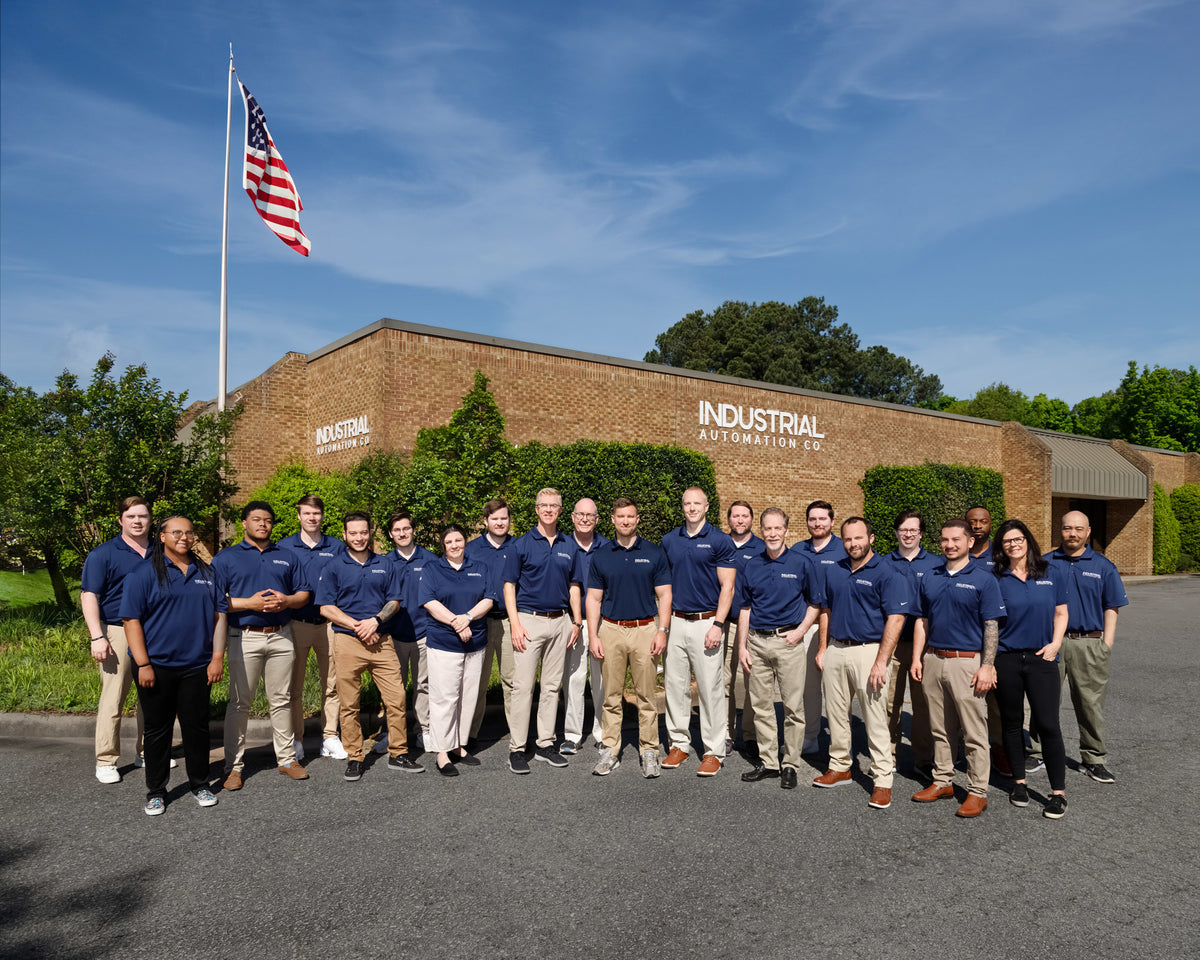
At Industrial Automation Co. we supply certified refurbished and new units from all of these brands — plus ABB, GE Fanuc, Toshiba, LS Electric, and more — all backed by a 2-year warranty. When your line is down, you don't have time to wait 8 weeks for a factory order.
In-stock parts ship the same day. Quotes in 5 minutes during business hours.
2-year warranty on every unit — new, refurbished, or repaired.
 2 Year Warranty on ALL products