Successfully Added
The product is added to your quote.


The product is added to your quote.


Expect your quote in 5 minutes or less during business hours.
We'll get back to you within 5 minutes during business hours.
Check your email at email@gmail.com for our response
.
If you’ve ever wired a proximity sensor to a PLC input and gotten unexpected results—or worse, damaged an input module—you’re not alone. The terms sinking and sourcing are among the most misunderstood concepts in industrial automation, yet they’re critical to getting PLC I/O wiring right.
Whether you’re new to PLC programming, installing a new control panel, or troubleshooting a system that “should work,” understanding the difference between sinking and sourcing is essential for safe, reliable operation.
In this guide, we’ll explain:
At the most basic level, sinking and sourcing describe the direction of current flow in a DC control circuit between a field device (such as a sensor) and a PLC input or output module.
Understanding this current path is the key to wiring sensors correctly and avoiding damaged PLC inputs.
In a sinking configuration:
Sensor → PLC → Ground
In a sourcing configuration:
PLC → Sensor → Ground
[VDC+] ───► [PNP Sensor] ───► [PLC Input (Sink)] ───► [GND]The PNP sensor sends +24VDC to the PLC input when activated.
[VDC+] ───► [PLC Input (Source)] ───► [NPN Sensor] ───► [GND]The NPN sensor completes the path to ground when activated.
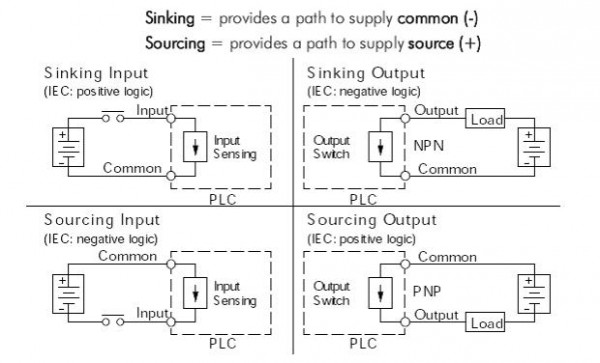
Before wiring any field device, always verify the PLC I/O module type.
Manufacturers typically label modules as:
This is the safest and most reliable method.
The COM terminal often reveals the module type:
| COM Connection | Module Type |
|---|---|
| 0VDC | Sinking Input |
| +24VDC | Sourcing Input |
Measure idle voltage at the input terminal:
Always follow lockout/tagout procedures before testing.
Some manufacturers historically favor certain configurations:
However, always verify the exact model number.
Industrial Automation Co. stocks a wide range of PLC I/O modules compatible with both sinking and sourcing applications.
The Siemens SM 1221 is a versatile digital input module commonly used with SIMATIC S7-1200 PLCs. Certain configurations support sinking and sourcing wiring depending on application requirements.
Ideal for:
The Siemens SM 1222 digital output module provides reliable output switching for industrial control applications and integrates seamlessly into Siemens PLC systems.
Common uses include:
The Omron CJ1W-ID211 is a dedicated sinking input module designed for use with NPN sensors and legacy industrial equipment.
Best suited for:
The Mitsubishi QX41 is a popular industrial digital input module designed for Mitsubishi MELSEC systems and supports sinking/sourcing style applications depending on wiring configuration.
Frequently used in:
This is one of the most common causes of PLC input failures and erratic operation.
Always verify sensor type before installation.
DC control circuits rely on polarity and current direction. AC wiring habits can cause major mistakes in PLC systems.
Connecting COM to the wrong polarity prevents inputs from switching properly.
Double-check wiring diagrams before energizing the system.
Some sensors require pull-up or pull-down resistors for proper operation.
Review sensor documentation carefully.
Using multiple 24VDC supplies without proper isolation can create ground loops and unpredictable behavior.
| Feature | Sourcing Input (PNP) | Sinking Input (NPN) |
| Current Direction | Sensor → PLC | PLC → Sensor → GND |
| Sensor Type | PNP | NPN |
| Common Connected To | 0VDC | +24VDC |
| Most Common Regions | North America, Europe | Asia-Pacific |
| Troubleshooting Simplicity | Easier | Moderate |
| Typical Modern Usage | High | Legacy Systems |
A PNP proximity sensor on a packaging line outputs +24VDC when detecting a target. It’s wired to a sinking PLC input with the common connected to 0VDC.
When metal is detected:
An NPN photoeye on a bottling machine connects to a sourcing PLC input.
When a bottle cap is detected:
Sinking and sourcing are not interchangeable. They determine how current flows through your industrial automation system.
Using the wrong combination of PLC input module and sensor can lead to:
When in doubt:
Understanding current flow is one of the most important fundamentals in PLC wiring and industrial automation.
Industrial Automation Co. stocks hundreds of PLC I/O modules, proximity sensors, digital inputs, and industrial automation components from trusted manufacturers including:
Whether you need replacement PLC parts, obsolete modules, or help selecting the right sinking or sourcing configuration, our team can help.
Contact Industrial Automation Co. today for expert support and competitive pricing on industrial automation components.
 2 Year Warranty on ALL products